 |
| Home Page |
| Conference Program |
| Call for Papers Oral/Posters |
| Registration Fees |
|
Registration
Form...
Open |
| Exhibitors |
|
Elective Activities If you have registered, you may add social events by linking to the following page: Update Electives |
|
Workshops (CE courses) If you have registered, you may add workshops by linking to the following page: Update Workshops |
| CE Credits |
| Conference Site |
| Maui, Hawaii |
| Administration |
 Sixth
Meeting of the Sixth
Meeting of theInternational Society for Maxillofacial Rehabilitation |
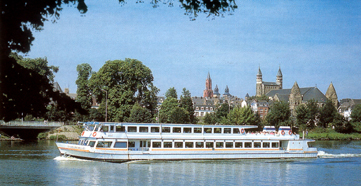 Maastricht, The Netherlands - June 17-19, 2004
In Cooperation with:
Division of Maxillofacial
Prosthetics of the Dutch Society for
Temporomandibular Disorders and Prosthetic Dentistry

Limburg,
the narrow, Southeastern province that is wedged between Belgium and Germany.
This is where there are rolling hills, caves and
castles. Where Romans ruled for more than four centuries. It is where the Dutch
go sightseeing and where Latin ancestry and cross-border influences make the
people different from their Northern compatriots. Here, white asparagus are
harvested in May, and grapes in the Fall and they eat a cheese that's called
"rommedoe", which rhymes with shoe and, some say, smells like an old
one. The capital of this province is Maastricht, a city, steeped in
history that has preserved much of the architectural evidence of that
past. 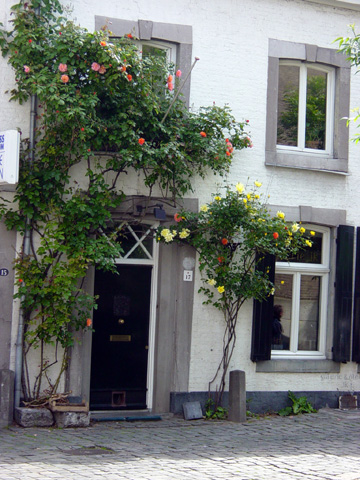
Maastricht is a congress city of international standing. Maastricht also has a reputation as a city of culture. The annual art and antiques fair The European Fine Art Fair (TEFAF) is world famous. The oldest city in The Netherlands, Maastricht's fascinating history places it in the center of the European past. historical monuments are beautifully preserved and readily accessible, and its museums boast unmatched collections which are carefully displayed. Nowhere else in Europe can you so easily see such a range of artifacts from the Roman period through the current century. And all of that past can be seen in the city's well- preserved monuments. Maastricht is a city of some 120,000 people located on the Maas River in Limburg, the southernmost province of The Netherlands. Over the years, Maastricht has been an important center of trade, industry, communications, and education. The city has a long tradition as a European crossroads, and its history has helped to make it a truly international city.
Fashion,
patisserie and antiques are particularly plentiful. The sophisticated shop
windows in the Stokstraat area are the height of temptation. The sunny lifestyle
of the people of Maastricht is infectious. Maastricht sparkles! Restaurants,
bars and pavement cafes around. Nowhere in the Netherlands will you find such a
choice of culinary delights within such a small radius. In Maastricht, students
and scholars alike can meet colleagues from all over the world, and enjoy
first-class research facilities, like the University of Limburg libraries and
the Maastricht Archives.
Combined with its central location and proximity to
many leading European universities, this helps make Maastricht a haven for
teaching and learning. The postwar years have seen the restoration of the city's
historic center, and a great expansion of trade and industry. The city is now
home to the University of Limburg and at least six other educational
institutions. Maastricht has begun to capitalize upon its history by emphasizing
its international character and its location in the heart of Europe.
In 1981 the city hosted the summit meeting of the EEC heads of state, and in 1991 the Treaty of Maastricht was negotiated and signed in the city. The creation of the EuroRegion centered on the cities of Aachen, Cologne, Li�ge, and Maastricht is a further sign that Maastricht is slowly ceasing to be a city on the frontier between two powers and is returning to the central European location it occupied during the reign of Charlemagne.
Make plans NOW... join us in this charming town for our 6th International Congress!
ISMR
Conference Administration
International Society for Maxillofacial Rehabilitation
RES Seminars
PO Box 99119
4425 Cass St., Suite A
San Diego, CA 92109
Tel: 1 (858) 272-6560
Fax: 1 (858) 272-7687
Email: [email protected]
Web Site: www.ismr-org.com